
My Child Vomited After Taking Medicine.
Should I Give Another Dose Of Medicine?
By Dr Soo
“Doctor, my child vomited after taking the medicine. Should I give another dose?“
It can be a stressful situation. After finally convincing your child to swallow the medicine, they suddenly vomit a few minutes later. Many parents immediately wonder whether the medicine has worked, whether the illness will worsen, or whether giving another dose could accidentally lead to an overdose.
The truth is that there isn’t a single answer for every situation. It depends on how long after taking the medicine your child vomited, the type of medication involved, and your child’s overall condition.
Understanding what usually happens can help you make a safer decision while knowing when it’s important to seek medical advice.
Why do children vomit after taking medicine?
Children may vomit after taking medication for several reasons.
Sometimes it has nothing to do with the medicine itself. Children who have viral infections, stomach flu, high fever, or persistent coughing may already be prone to vomiting.
In other cases, the medicine may have triggered it. Some medications have a bitter taste, an unpleasant smell, or can irritate the stomach. Young children also have a very sensitive gag reflex, so even swallowing a spoonful of medicine may make them vomit.
Occasionally, vomiting happens because the child was crying excessively before taking the medicine or because the medicine was given immediately after a large meal.
The important thing is not to panic. Instead, consider how long the medicine stayed in your child’s stomach before the vomiting occurred.
The 15-30-30 Rule
Although every medication is different, healthcare professionals often use a practical timing guide.
If your child vomits within 15 minutes
In general, you may repeat the full dose.
At this stage, the medicine has probably not had enough time to leave the stomach and be absorbed into the bloodstream.
If you notice that almost the entire dose of medicine came back up immediately after swallowing, repeating the dose is usually reasonable.
However, if your child vomits again after the repeated dose, do not continue giving additional doses. Instead, contact your doctor for further advice.
If your child vomits between 15 and 30 minutes
This is the “grey area.”
Some medicines begin to be absorbed quite quickly, while others remain in the stomach longer.
Because absorption varies depending on the medication, your child’s age, whether the medicine was taken with food, and the illness itself, there is no universal recommendation.
If you’re unsure, it is safest to contact your doctor, pharmacist, or the clinic that prescribed the medicine before giving another dose.
If your child vomits after 30 minutes
In most cases, do not repeat the dose.
By this time, much of the medication has likely already been absorbed.
Giving another full dose could potentially result in your child receiving more medication than intended.
Instead, simply continue with the next scheduled dose unless your doctor advises otherwise.
Does this rule apply to every medicine?
No.
This timing guide is helpful for many commonly prescribed medications, but some medicines require special consideration.
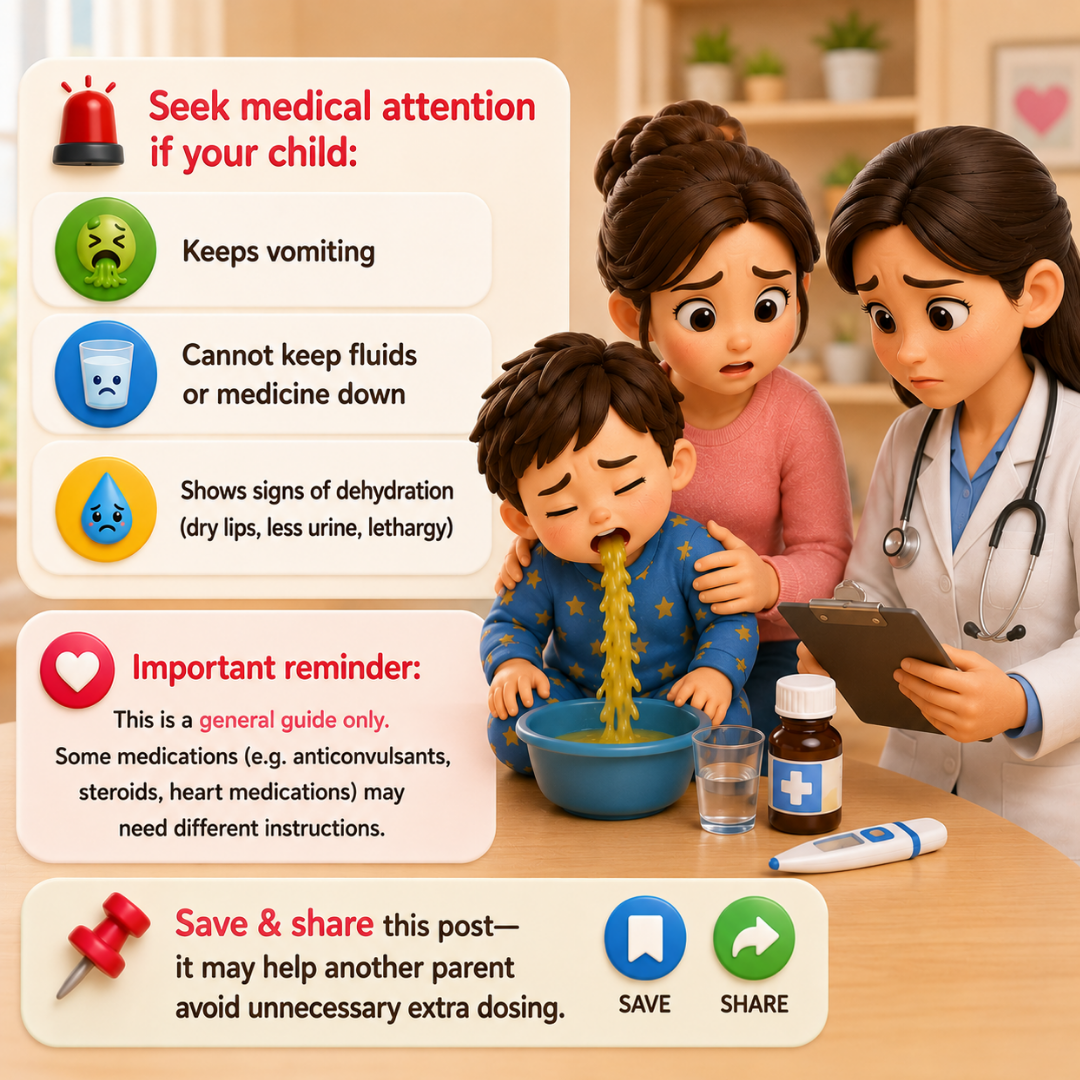
Certain medications are especially important because missing even one dose may affect seizure control, hormone replacement, heart function, or other critical medical conditions.
Examples include:
- Anticonvulsants (for epilepsy)
- Steroids
- Heart medications
- Some hormone medications
- Certain immunosuppressive medicines
If your child vomits after taking these medications, you should contact your doctor promptly for individual advice rather than relying solely on the timing guide.
Signs your child may be becoming dehydrated

Vomiting itself is usually not dangerous.
The bigger concern is when repeated vomiting leads to dehydration.
Watch for warning signs such as:
- Dry lips and mouth
- No tears when crying
- Sunken eyes
- Passing very little urine
- Dark yellow urine
- Extreme sleepiness
- Poor responsiveness
- Refusing to drink
- Persistent vomiting
Young babies can become dehydrated much more quickly than older children.
If you notice any of these signs, seek medical attention promptly.
Tips to reduce vomiting after medicine
1. Give medicine slowly
Avoid squirting the entire syringe into the back of your child’s throat.
Instead, gently place the medicine into the side of the cheek and give it slowly.
2. Avoid forcing the medicine
If your child is struggling, crying heavily, or gagging, forcing the medicine may increase the likelihood of vomiting.
Remain calm and try again after a short break if appropriate.
3. Follow food instructions
Some medicines work better with food, while others should be taken on an empty stomach.
Always follow the instructions provided by your doctor or pharmacist.
4. Use an oral syringe
Oral syringes are usually much more accurate than teaspoons and help deliver the medicine more slowly.
5. Ask about different formulations
If your child consistently vomits one type of medicine because of its taste, your doctor may be able to prescribe an alternative formulation.
When should you seek medical attention?
Please arrange a medical review if your child:
- Keeps vomiting every dose of medicine
- Cannot keep fluids down
- Shows signs of dehydration
- Has severe abdominal pain
- Becomes unusually sleepy or difficult to wake
- Has difficulty breathing
- Develops repeated green (bilious) vomiting
- Has blood in the vomit
- Is an infant younger than 3 months with persistent vomiting
- Has a medical condition requiring critical medications
Your doctor can assess whether the illness itself is causing the vomiting or whether changes to the treatment plan are needed.
A message for parents
Watching your child vomit after taking medicine can be frustrating, especially when you’re trying your best to help them recover. Fortunately, in many cases, there is no need to panic.
A simple way to remember is:
- Within 15 minutes: Usually repeat the full dose.
- 15–30 minutes: Check with your healthcare provider.
- After 30 minutes: Usually, do not repeat the dose.
Keep in mind that this is a general guide, and some medications require individual advice. If you’re ever unsure, don’t guess. Contact your doctor or pharmacist—they’re there to help.
Most importantly, focus on your child’s overall condition rather than the medicine alone. If your child is unable to keep fluids down, becomes dehydrated, or seems increasingly unwell, seek medical attention promptly.
With the right guidance and careful observation, most children recover well, and parents can feel more confident about managing these common situations at home.

Dr Soo Hui Fang